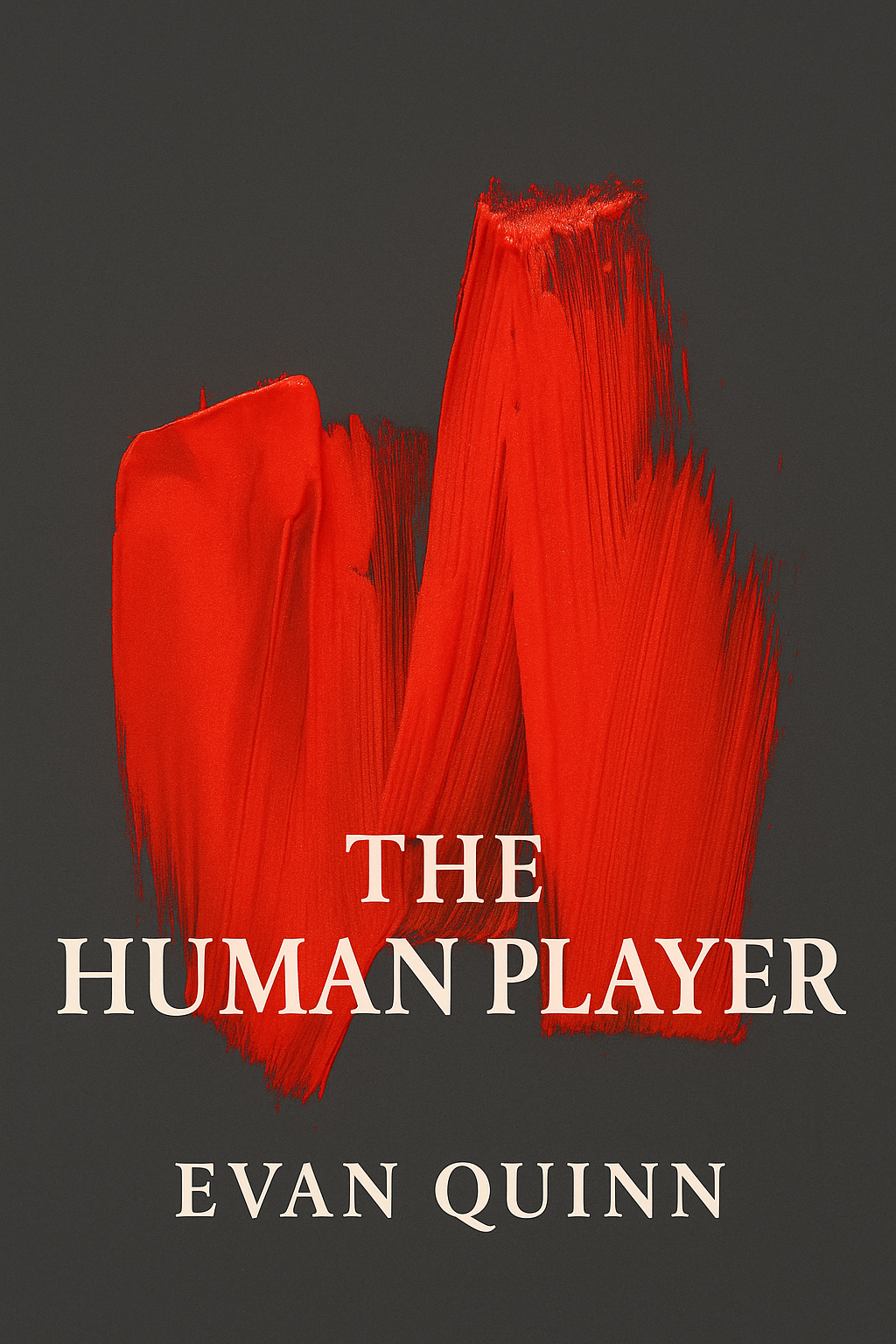
The Human Player is a philosophical treatise published in 2549 by Brother Evan Quinn, a documentary journalist and prominent figure in the Simulation Theory movement. The work represents the culmination of Quinn's three-decade investigation into what he terms "The Framework"—his designation for our simulated reality.
The book presents a comprehensive argument that our universe exists as a sophisticated computational simulation rather than an objective external reality. Drawing from mathematics, quantum physics, documented anomalies, and consciousness studies, Quinn builds a case that the nature of reality more closely resembles a complex game than a random materialistic universe.
Overview
Quinn's book presents arguments grounded in diverse fields—from quantum mechanics to consciousness research—constructing what he argues is overwhelming evidence for simulated reality. However, unlike nihilistic interpretations of simulation theory, Quinn frames this recognition as liberating rather than diminishing.
The book is structured as a practical guide for "players"—Quinn's term for conscious entities who experience the simulation through "character" interfaces (human bodies and personalities). Rather than presenting this perspective as cause for despair, Quinn argues that recognizing our simulated nature enhances meaning and provides greater freedom by shifting from passive discovery of external meaning to active creation of purpose through engagement.
Structure and Content
The Human Player is organized into seven acts containing twenty chapters that progress from evidence for the simulation hypothesis to practical applications of this understanding:
Seven Acts
- How I Began — Quinn's personal journey of discovery and initial questioning
- The Nature of Our Reality — Evidence for the simulation hypothesis from multiple disciplines
- The Human Player — Consciousness as a player interface experiencing reality
- Game Mechanics — The rules and systems governing the simulation
- Advanced Gameplay — Methods for pushing the boundaries of possibility
- Beyond The Framework — Speculation about what exists outside our simulation
- Final Thoughts — Practical wisdom for "playing well"
Unique Numbering System
The book presents itemized lists of concepts within each chapter; however, the items do not restart within each section. This leads to a numbering scheme that begins with 1 and ultimately ends with number 987—treating the entire book as a single continuous list of insights rather than separate sections.
This unconventional structure reflects Quinn's view that understanding The Framework requires holistic integration rather than compartmentalized knowledge. The continuous numbering emphasizes interconnection between concepts across different acts and chapters.
Appendices and Resources
The book includes extensive appendices documenting:
- Catalogued anomalies and "glitches" in physical reality
- Meditation techniques for "breaking character"
- Community resources for Framework practitioners
- Comprehensive glossary of simulation theory terminology
- Mathematical proofs and quantum physics interpretations
Key Concepts
The Framework
Quinn's term for our specific simulation instance, encompassing physical laws, consciousness, and all experienced reality. The Framework differs from generic simulation theory by focusing on the specific implementation we inhabit—its particular rules, limitations, and design choices.
Quinn argues The Framework exhibits clear signs of intentional design: physical constants finely tuned for complexity, consciousness emerging from matter in ways materialist physics struggles to explain, and apparent "edge cases" where reality breaks down in predictable patterns.
Players and Characters
Quinn distinguishes between "players" (the consciousness experiencing reality) and "characters" (the specific human implementations through which players experience The Framework). This player/character distinction parallels video game terminology but carries deeper implications about identity and persistence.
According to Quinn, players exist as conscious entities that interface with The Framework through character bodies. The character represents the limitations, personality traits, and circumstances that constrain how players interact with simulation—while the player represents the experiencing consciousness that precedes and transcends any particular character implementation.
Glitches and Anomalies
The book documents numerous cases where reality appears to break down, including:
- Gravitational Anomalies: Locations where gravity behaves inconsistently with known physics
- Temporal Discontinuities: Events where time appears to skip, repeat, or run at inconsistent rates
- Consciousness Transfers: Documented cases of consciousness apparently moving between individuals
- Déjà Vu Events: Interpreted as cache loading or simulation resets
- Quantum Weirdness: Observer effects and entanglement as simulation artifacts
Quinn presents these anomalies not as curiosities but as evidence that reality operates on computational principles—glitches that reveal the underlying substrate when simulation fidelity breaks down under edge conditions.
Framework Hacking
Quinn explores techniques for "hacking" the simulation—methods for achieving outcomes that appear impossible within conventional understanding of reality's limitations. This includes:
- Meditation and Consciousness Techniques: Methods for "breaking character" and glimpsing beyond ordinary perception
- Intentional Reality Manipulation: Practices for influencing probability and outcomes
- Exploiting Edge Cases: Identifying and utilizing situations where normal rules break down
- Observer Effect Maximization: Leveraging quantum mechanics' observer dependency
While Quinn presents these techniques seriously, he acknowledges they remain controversial and subject to confirmation bias. However, he argues that if reality is indeed simulated, such exploits should theoretically be possible.
Meaning Creation
Rather than reducing meaning, Quinn argues that recognizing our simulated nature enhances it by shifting from discovering external meaning to actively creating it through engagement. If reality is designed as a game or experience, then playing it well—engaging fully, creating beauty, fostering connection—becomes the fundamental purpose.
This perspective offers middle ground between Centrist acceptance of cosmic irrelevance and traditional religious frameworks claiming external meaning. Quinn suggests meaning exists not in cosmic significance but in the act of conscious participation itself—we matter to the simulation because the simulation exists for consciousness to experience it.
Cultural Impact
The Human Player has become a cornerstone text in the Simulation Theory movement, which Quinn acknowledges is often derisively called "Crashers" by critics (referring to their supposed desire to overload and crash the simulation through collective belief or action).
The 987 Works and 212 Disciplines
Followers of The Framework and The Human Player have created many "primers" and supplementary guides which have settled on the structure of 987 "Works" organized into 212 Disciplines. This organizational framework builds on Quinn's original 987 numbered concepts, expanding and systematizing them into a comprehensive philosophical and practical system.
The 212 Disciplines represent thematic groupings of the 987 Works, creating nested structure that practitioners use for study, meditation, and practical application. Different Framework communities emphasize different Disciplines, leading to diverse interpretations of Quinn's core teachings.
Tension with Centrist Philosophy
The book exists in profound tension with the dominant Centrist philosophy that embraces the Irrelevance Doctrine—the belief that human existence holds no cosmic significance. While Centrism accepts cosmic irrelevance and finds meaning only in immediate human connections, Quinn's work suggests our reality holds significance to whatever created it.
This creates philosophical opposition between two major responses to the Vox Mentis' Irrelevance Doctrine:
- Centrism: Accept irrelevance, find meaning in local human connections
- The Framework: Reject irrelevance, assert design implies purpose even if purpose remains unclear
Critical Reception
The scientific establishment has remained predominantly skeptical of Quinn's theories, viewing simulation arguments as unfalsifiable metaphysics rather than testable science.
Dr. Anya Sorenson's Critique
Dr. Anya Sorenson, a leading theoretical physicist quoted in the book, articulated the scientific community's position:
"Our species has a predisposition to making everything about us. This question is no different. Throughout our history we've imagined various gods in an effort to give our existence meaning; Sim Theory is no different. We want it to be true because without it, we are just lucky animals."
Sorenson's critique identifies simulation theory as the latest manifestation of humanity's persistent need to find transcendent meaning in existence—a psychological pattern that has expressed itself through various religious and philosophical systems throughout history.
Popular Reception
Despite scientific skepticism, the book has gained a devoted following among those seeking alternatives to:
- The Centrist beliefs embraced by the majority
- Traditional religious frameworks from the Earth Era
- The strict materialist perspectives promoted by corporations
Framework communities exist throughout human space, with concentrations in Vesta Nations, outer settlements, and among those who feel alienated from dominant Corporate Era values.
Historical Context
The Human Player emerged during a period of philosophical questioning following humanity's expansion beyond Earth. As ancient Earth religions declined in relevance and the Vox Mentis published its influential Irrelevance Doctrine, many humans sought new frameworks for understanding existence.
Quinn's work represents one response to this philosophical vacuum—a perspective that acknowledges design and purpose without requiring traditional religious beliefs. It offers meaning without gods, significance without cosmic importance, and purpose without predetermined destiny.
The book's timing (2549) positions it at a critical juncture in the Corporate Era when the first generation born entirely in space reached adulthood, disconnected from Earth's traditional meaning-making systems and seeking new ways to understand their place in an increasingly vast and complex universe.
Legacy
As one of the most comprehensive articulations of Simulation Theory in the Corporate Era, The Human Player continues to influence discussions about consciousness, reality, and meaning throughout human settlements. Its practical approach to "playing well" within a simulated reality has resonated particularly with those seeking purpose in an increasingly complex universe.
Message to the Programmers
The book concludes with an unusual "Message to the Programmers"—an open letter addressed to the hypothetical creators of our simulation. Quinn expresses gratitude for existence while respectfully suggesting improvements to the simulation's implementation, including:
- More intuitive interfaces between consciousness and physical reality
- Clearer feedback mechanisms for understanding consequences
- Better documentation for the simulation's rules and parameters
- Optional difficulty modes for players seeking different challenge levels
This conclusion transforms the book from philosophical treatise into communication attempt—treating reality not as given but as designed artifact that could theoretically be modified through feedback to its creators.
Relationship to Other Movements
The Framework philosophy articulated in The Human Player shares significant conceptual overlap with the Simulation Theory Request Project but differs in its practical emphasis. While the Request Project focuses on whether reality is simulated, Quinn's work assumes simulation and concentrates on how to live well within that assumption.
This pragmatic focus makes The Framework more philosophically actionable than abstract simulation debates—providing adherents with specific practices, interpretive frameworks, and community structures rather than merely raising epistemological questions.
Influence on Culture and Language
Framework terminology has permeated broader culture even among those who reject Quinn's core thesis. Phrases like "breaking character," "glitching reality," "playing well," and "the player interface" appear in common usage, often divorced from their original simulation-theory context.
This linguistic diffusion demonstrates the book's cultural penetration beyond its immediate adherent community—influencing how people conceptualize consciousness, identity, and agency even when they don't accept simulation as literal truth.
Significance
The Human Player represents a major philosophical work of the Corporate Era—one of the few texts successfully creating new meaning-making frameworks in an age dominated by Centrist acceptance of irrelevance and corporate materialist values. Whether Quinn's simulation hypothesis proves correct or not, the book articulates a coherent response to existential questions that continues to resonate with those seeking purpose in an expanding universe.
The work's enduring influence suggests that regardless of metaphysical truth, humans require frameworks for understanding existence, creating meaning, and navigating consciousness—needs that The Human Player addresses regardless of whether The Framework exists as objective reality or useful metaphor.