Historical Significance
Brother Evan Quinn is primarily known for his groundbreaking journalistic coverage of corporate conflicts and his controversial philosophical work on simulation theory. His seminal text, "The Human Player" (2549), established him as the foremost proponent of the theory that reality exists as a sophisticated computational construct called "The Framework." Quinn's theories have significantly influenced contemporary metaphysical discourse despite ongoing academic debate regarding their validity.
Early Life
Born in Novaterra to documentary filmmakers, Quinn was orphaned at six months when his parents disappeared while attempting to access an uncharted QETS gate. Raised in a Novaterra birthing unit until age five, he was subsequently apprenticed to a collective of Vox Echoes who provided his education and early training in information sciences.
Professional Development
Early Career (2521-2532)
At age 22, Quinn departed Novaterra to pursue documentary journalism. His early work focused on corporate-worker relations and emerging conflicts in the asteroid belt. This period culminated in his coverage of the Texas Station Stand-off (2532), which established his reputation for unflinching documentation of corporate activities.
Major Investigations (2532-2549)
Quinn's professional trajectory encompassed several landmark investigative projects:
- Texas Station Stand-off (2532): Documented Void Corp's attempted seizure of TX300 Facility
- The Bloody Sands Conflict (2534): Provided crucial eyewitness accounts of Void Corp's mercenary attack on Varuna Outpost
- Battles of Vesta Nations: Extensive coverage of multiple conflicts between independent miners and corporate entities
- Ixion Mines Crisis (2549): Documented the catastrophic life-support failure attributed to TerraExtract's negligence
The Human Player
Written during and immediately following his coverage of the Ixion Mines Crisis, "The Human Player" (2549) presents Quinn's comprehensive argument that reality exists as a sophisticated simulation he calls "The Framework." The book draws heavily from his first-hand observations of anomalies during various crises, particularly focusing on:
- A miner's impossible survival without oxygen during the Ixion Mines Crisis
- The synchronized 22-minute memory gap experienced by multiple witnesses during the Texas Station Stand-off
- Documented cases of gravitational anomalies and temporal discontinuities
Intellectual Contributions
Quinn's primary contribution to contemporary thought lies in his development of simulation theory, particularly his concept of "The Framework." His approach synthesizes:
- Observational evidence from corporate conflict zones
- Quantum mechanical anomalies
- Statistical analysis of improbable events
- Philosophical examination of consciousness phenomena
Methodological Approach
Quinn's investigative methodology combines direct observation with pattern recognition. He maintains first-hand documentation of events, identifies statistical anomalies across seemingly unrelated incidents, cultivates extensive informant networks, and triangulates accounts from multiple perspectives to verify his findings.
Critical Reception
Academic and public response to Quinn's work remains sharply divided.
Supportive perspectives note his meticulous documentation meets journalistic standards, the consistency of observed anomalies suggests underlying patterns, and the explanatory power of his framework addresses numerous philosophical questions.
Critical perspectives raise concerns about the potential psychological impact of trauma from witnessing multiple conflicts, questions regarding confirmation bias in pattern identification, and his current corporate affiliations potentially influencing theoretical positions.
Current Position
Quinn currently serves as a high-profile journalist at EuroCore Pulse under a contractual arrangement with CEO Crispin Ashford. This lucrative agreement notably restricts his investigative activities regarding Void Corp and its corporate partners. Despite these constraints, he remains among the top 100 wealthiest individuals in known space and continues to influence contemporary philosophical discourse.
Cultural Impact
Quinn's theories have spawned a significant philosophical movement. Adherents of "Sim Theory" (colloquially known as "Crashers") have developed structured belief systems around his framework. His wealth and prominence have positioned him as one of the most influential intellectual figures of the Corporate Era.
Notable Quotation
"The Vox handles 648 trillion requests per minute from the human population of the universe. The fact that, when asked about the probability of this world being a simulation, The Vox basically said 'I don't know. Let me get back to you' should give our species a reason to pause and consider."
Physical Appearance
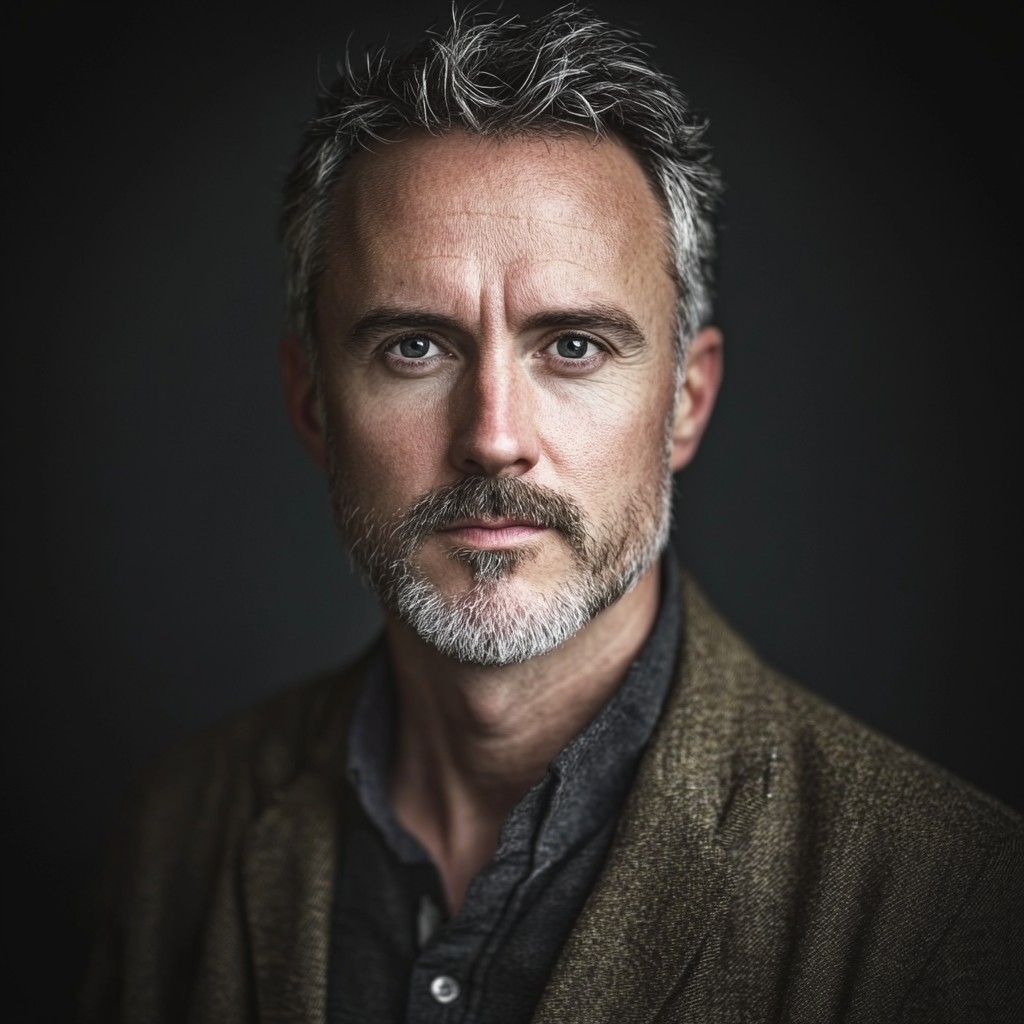
Quinn presents as a handsome man in his early fifties with salt-and-pepper hair, a neatly groomed beard, and piercing blue-gray eyes. He typically dresses in a style reminiscent of ancient academic and media professionals, favoring textured brown blazers over dark shirts.
Relationships
- Professional: Complex relationship with Crispin Ashford, balancing between benefactor and constraint
- Media Colleagues: Regular interactions with Nila Chandra and Emilia Novak on EuroCore Pulse
- Sim Theory Community: Respected figure among followers of Sim Theory
- Sources: Maintains a vast network of confidential informants despite current restrictions