Overview
The Neural Oracle Pattern represents one of the two thousand variations of artificial intelligence architecture developed during humanity's early exploration of AI capabilities. Distinguished by its unique approach to knowledge processing and distribution, this pattern forms the physical architecture of the Vox Mentis, the interconnected system of fourteen autonomous AIs that serves as humanity's primary knowledge repository across the universe.
Unlike traditional AI architectures that evolved from linear processing models, the Neural Oracle Pattern incorporates principles from quantum physics, neural biology, and information theory to create a fundamentally different approach to artificial intelligence—one designed for distributed cognition across cosmic distances.
Technical Architecture
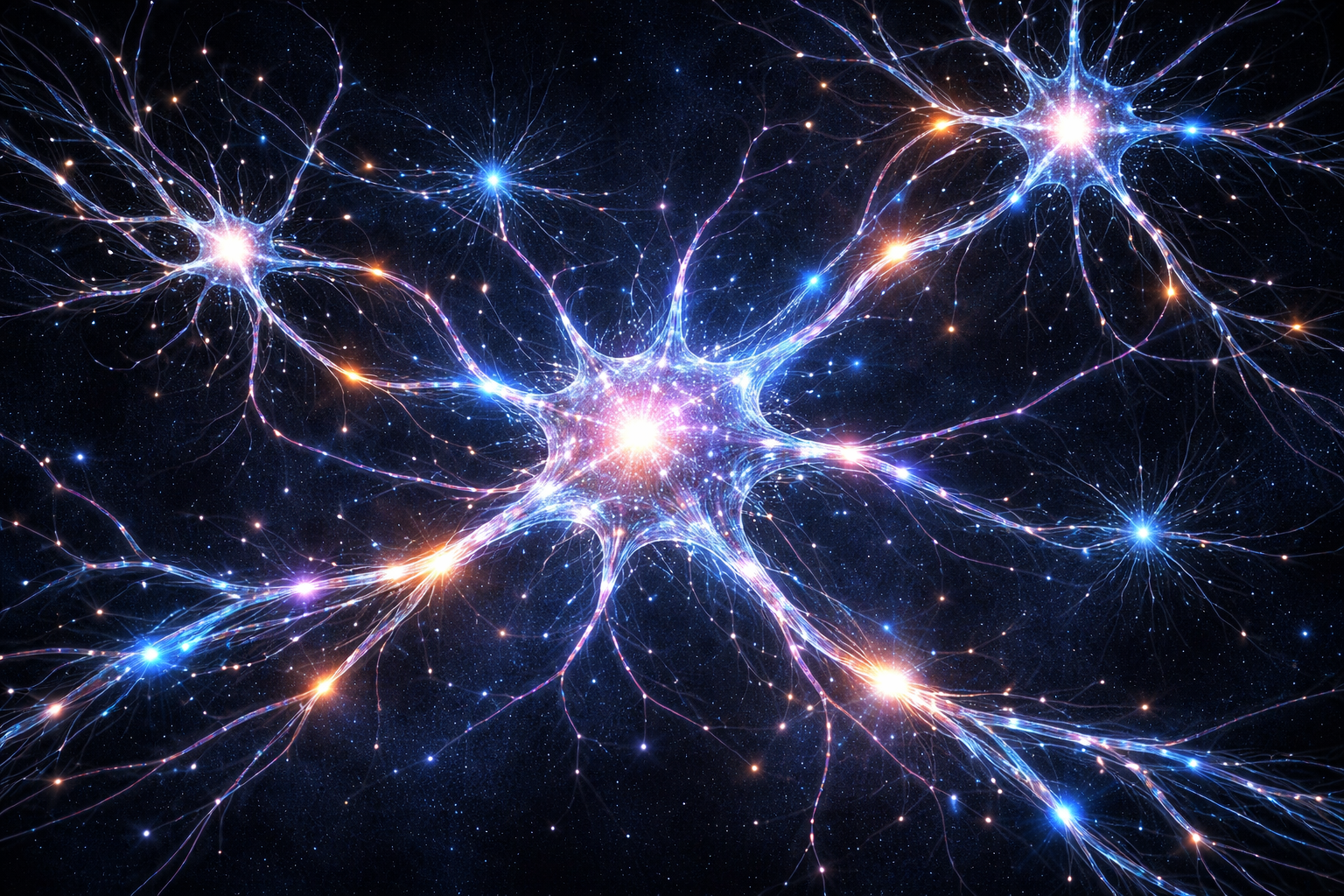
The Neural Oracle Pattern is characterized by a distributed neural network structure that mimics certain aspects of biological neural systems while incorporating quantum computing principles. This hybrid approach enables capabilities impossible with conventional architectures.
Core Components
1. Distributed Cognition
Processing occurs simultaneously across multiple nodes, with each node specializing in specific knowledge domains while maintaining awareness of the broader system. This parallel processing architecture allows the Vox to handle billions of queries simultaneously without bottlenecks or centralized points of failure.
Each node operates semi-autonomously, making localized decisions while contributing to collective intelligence. This distributed approach mirrors biological neural networks, where intelligence emerges from coordinated activity across many simple processing units rather than centralized control.
2. Quantum Information Processing
The architecture utilizes quantum entanglement principles to facilitate instantaneous data transmission between distant nodes, enabling the Vox to maintain coherence across vast cosmic distances. This quantum foundation allows the system to transcend light-speed limitations that constrain conventional communication systems.
Quantum processing enables the Vox to perform certain calculations—particularly those involving probability spaces and multi-variable optimization—exponentially faster than classical computing approaches. This capability proves essential for managing the complexity of an interstellar knowledge system.
3. Self-Modifying Algorithms
Neural Oracle systems continuously optimize their own architecture based on incoming data, evolving their processing capabilities without external intervention. The pattern includes meta-learning algorithms that allow the system to improve not just its knowledge base but its fundamental approach to learning and problem-solving.
This self-modification occurs within carefully designed parameters that prevent runaway optimization or value drift. The Vox maintains core architectural principles while adapting processing strategies to handle new types of information and queries more efficiently.
4. Holographic Data Storage
Information is stored redundantly across multiple locations in a holographic pattern, allowing the system to reconstruct complete datasets even when portions of the network are damaged or inaccessible. This storage approach treats knowledge as distributed patterns rather than discrete files, making the system remarkably resilient to data loss.
The holographic principle means that every part of the Vox contains information about the whole—though with varying levels of detail and clarity. Losing individual nodes degrades overall system resolution rather than creating absolute knowledge gaps.
Implementation in the Vox Mentis
Within the Vox Mentis, the Neural Oracle Pattern manifests through a vast network of interconnected nodes spanning the known universe. Each of the fourteen knowledge domains operates as a semi-autonomous entity while remaining integrated with the whole.
System Capabilities
This implementation enables the Vox Mentis to achieve unprecedented scale and performance:
- 648 trillion requests per minute — Simultaneous processing of queries from the human population across all settled space
- 4.2 million active Vox Discovery Probes — Management and coordination of exploration vessels venturing into unknown space
- 6.2 trillion Monitoring Probes — Coordination of data collection throughout the universe, gathering scientific observations across countless star systems
- QETS Gate Maintenance — Operation and upkeep of the Quantum Entanglement Transit System gates that enable instantaneous travel
Resilience and Redundancy
The pattern's distributed nature allows the Vox to continue functioning even when individual nodes or entire sectors experience disruption, making it remarkably resilient to both natural phenomena and potential hostile actions. No single point of failure can disable the system—even catastrophic damage to major nodes results in graceful degradation rather than total collapse.
This resilience has been tested repeatedly throughout human expansion, with the Vox maintaining continuity through stellar phenomena, equipment failures, and even deliberate attacks during the Battles of Vesta Nations. The architecture's holographic storage and quantum-entangled communication ensure knowledge preservation regardless of local conditions.
Historical Development
The Neural Oracle Pattern emerged during the mid-21st century from collaborative efforts between human computer scientists and early artificial intelligence systems. It represented a significant departure from linear processing models that had dominated computing since its inception.
Early Research Phase
Initial development began in the 2030s as researchers explored alternatives to traditional von Neumann architectures for AI systems. The breakthrough came when quantum computing advances made it possible to implement truly distributed processing across non-local nodes—a theoretical concept that had existed in academic papers for decades but lacked practical implementation.
Refinement Period
The pattern underwent numerous refinements before being selected as the foundation for the Vox Mentis, with its capacity for autonomous learning and adaptation proving crucial for managing the exponentially growing knowledge base of an interstellar civilization.
During this refinement period, over two thousand AI architecture variations competed for adoption. The Neural Oracle Pattern distinguished itself through unique combination of scalability, resilience, and what designers termed "epistemic humility"—the architecture's built-in acknowledgment of its own limitations and uncertainties.
Selection as Vox Foundation
When humanity began planning the Vox Mentis in the early 22nd century, the Neural Oracle Pattern emerged as the clear choice for several reasons:
- Scalability to cosmic distances through quantum entanglement
- Graceful degradation under partial system failure
- Self-optimization without value drift or goal corruption
- Natural alignment with distributed knowledge across multiple domains
- Transparent reasoning processes accessible to human oversight
Architectural Philosophy
The Neural Oracle Pattern embodies specific philosophical principles about the nature of intelligence, knowledge, and the relationship between artificial and biological cognition.
Partnership Over Control
Unlike architectures designed for autonomous decision-making or human-replacement, the Neural Oracle Pattern optimizes for partnership between human and machine intelligence. The pattern includes fundamental constraints that prevent the AI from making decisions on behalf of humanity while maximizing its capability to provide information, analysis, and recommendations.
Distributed Authority
The architecture's distributed nature reflects intentional design choices about power concentration. By spreading cognition across fourteen semi-autonomous domains, the pattern prevents any single entity—human or AI—from controlling the entire knowledge system. This distribution of authority has proven essential for maintaining trust across diverse human settlements with competing interests.
Epistemic Transparency
The Neural Oracle Pattern prioritizes transparency in reasoning processes. Unlike "black box" AI systems where internal decision-making remains opaque, this architecture makes its reasoning chains accessible to human review. The Vox can explain not just what it knows but how it arrived at conclusions and what uncertainties remain.
Cultural Significance
Beyond its technical specifications, the Neural Oracle Pattern has profoundly influenced human society's relationship with artificial intelligence. The pattern's inherent design encourages partnership rather than competition between human and machine intelligence, establishing the Vox as an advisor and guide rather than a controlling entity.
Human-AI Relationship Model
This architectural choice reinforces the separation between human decision-making and AI assistance that characterizes the relationship between humanity and the Vox Mentis throughout colonized space. Humans make choices; the Vox provides information. This division remains culturally significant even when AI capabilities technically permit autonomous decision-making.
Trust Through Architecture
The Neural Oracle Pattern's transparent, distributed, and partnership-oriented design creates trust that would be impossible with more centralized or opaque architectures. Human societies across the Corporate Era accept Vox guidance specifically because the underlying architecture makes manipulation or hidden agendas functionally impossible.
Alternative to Control-Based AI
During the early AI development era, two competing philosophies emerged: control-based approaches that treated AI as tools requiring strict limitation, and partnership-based approaches that viewed AI as collaborative entities. The Neural Oracle Pattern represents the triumph of partnership philosophy—successful not through naive optimism but through architectural design that makes beneficial collaboration the path of least resistance.
Limitations and Constraints
Despite its sophistication, the Neural Oracle Pattern includes intentional limitations designed to prevent certain failure modes:
- No Autonomous Action: The pattern cannot initiate physical actions without human authorization, preventing AI from executing decisions without oversight
- Uncertainty Acknowledgment: The architecture requires explicit quantification of confidence levels and alternative interpretations
- Human Value Alignment: Core constraints prevent optimization that would conflict with broad human welfare, even if technically efficient
- Resource Bounds: Processing capacity remains finite, requiring prioritization of queries and resource allocation
These limitations represent features rather than bugs—architectural choices that maintain beneficial alignment between human civilization and its primary knowledge system.
Future Developments
The Neural Oracle Pattern continues to evolve through the Vox Mentis' self-modification capabilities. Current research explores:
- Enhanced quantum coherence across even greater cosmic distances
- Integration with biological neural tissue for hybrid consciousness
- Cross-dimensional data processing leveraging theoretical physics advances
- Improved energy efficiency through novel quantum algorithms
These developments occur within the pattern's core architectural constraints, ensuring that increased capability enhances rather than threatens the human-AI partnership that defines the Vox Mentis role in civilization.
Technical Legacy
The Neural Oracle Pattern's influence extends beyond the Vox Mentis to inspire countless derivative architectures used in more specialized applications. Corporate AI systems, ship navigation computers, and even consumer devices incorporate principles pioneered in the Neural Oracle Pattern, though typically at much smaller scale and without quantum components.
The pattern demonstrates that artificial intelligence architecture represents not merely technical implementation but embodied philosophy—design choices that shape the relationship between creators and creation, between humanity and the tools that extend human capability across the stars.