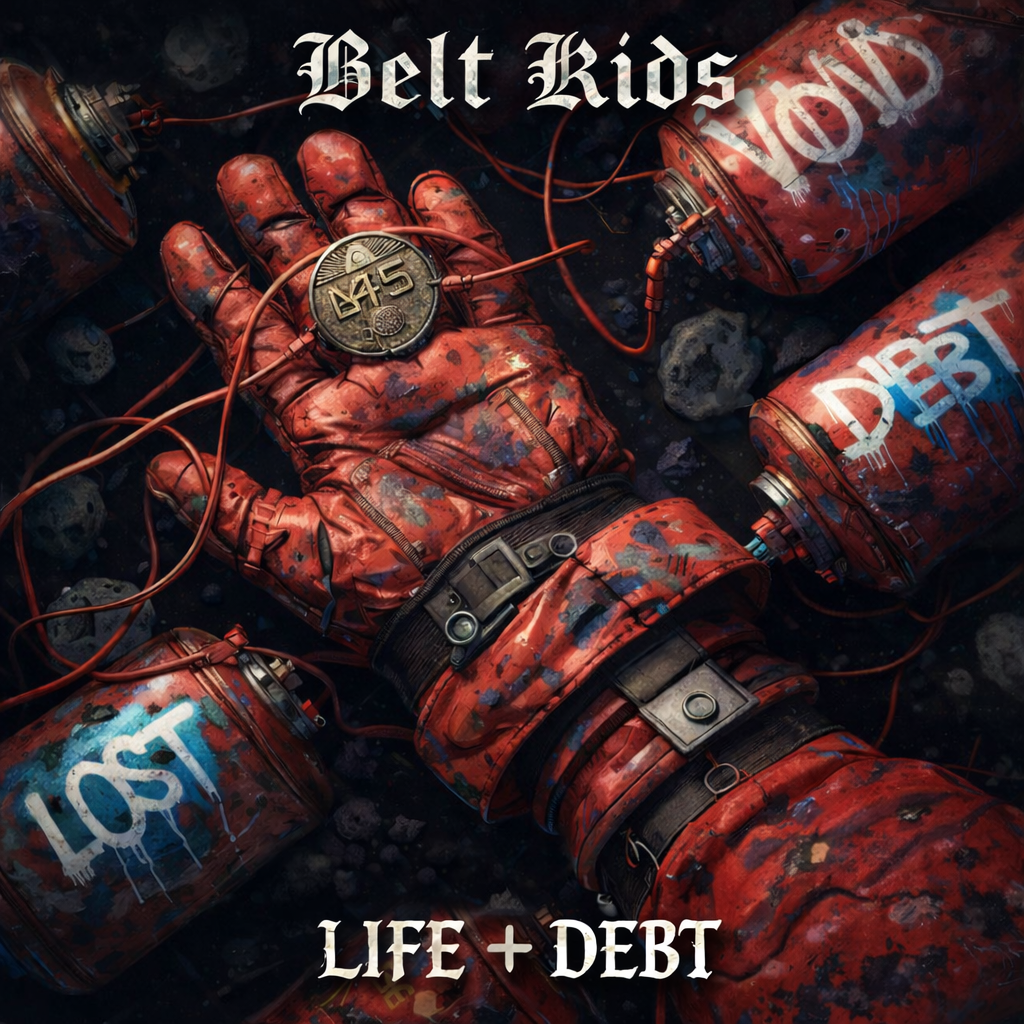
"Belt Kids" is the breakthrough arena rock anthem by the Vesta Nations band Life+Debt, released in 2554. The song has achieved universal recognition throughout human-inhabited space, becoming particularly emblematic of working-class identity in the asteroid belt mining communities and the broader Vesta Nations region.
Musical Composition
The track features Cruz Valle's distinctive gravelly vocals layered over driving guitar riffs, with Tess Albright's thunderous percussion providing the industrial heartbeat that mirrors the mechanical rhythms of mining operations. Dario Fennick's bass and synthesizer work creates a sonic landscape that alternates between the vast emptiness of space and the claustrophobic confines of mining vessels.
The song's production captures the dual nature of asteroid belt work—the infinite silence of space punctuated by the violent noise of industrial extraction. This sonic contrast makes "Belt Kids" immediately recognizable and viscerally connected to the physical experience of mining labor.
Thematic Content
The song captures the lived experiences of young miners and cargo haulers operating in the asteroid belt, addressing multiple interconnected themes:
Industrial Hardship
References to "orey" dust (a combination of mining byproduct and interstellar dust), magnetic boots, and the laser-lighting used to align connected cargo containers on a barge provide a vivid picture of harsh working conditions. These specific technical details ground the song in authentic experience, resonating powerfully with those who live this reality daily.
Systemic Resistance
The recurring motif of "breaking the frame" serves as both a rejection of The Framework (as understood in Simulation Theory) and a broader challenge to corporate control. Workers in Vesta Nations are frequently urged to "break the frame" and develop workarounds to regulations to get the job done—prioritizing practical problem-solving over bureaucratic compliance.
This dual meaning creates layers of interpretation: for Framework believers, it's about transcending simulated reality; for workers, it's about creative resistance to corporate constraints; for philosophers, it's about rejecting predetermined limits on human potential.
Collective Identity
The term "belt kids" itself has become a badge of honor among young workers throughout the outer settlements. The phrase captures both youth and resilience—"kids" suggesting the relative youth of many asteroid workers, while simultaneously implying the hard-won maturity that comes from surviving in one of the harshest environments human civilization has reached.
Cultural Impact
Working-Class Anthem
"Belt Kids" has transcended its origins as a rock song to become a rallying cry for the mining and cargo transport communities. The song is frequently played in common areas of Port Odessa as workers relax after long, multi-week shifts. It has been adopted as an unofficial anthem by various freeminer unions throughout the Vesta Nations.
The song appears at labor gatherings, memorial services for miners lost in accidents, and celebrations marking successful operations. Its presence marks these events as authentically working-class spaces, distinct from corporate-sanctioned entertainment.
Linguistic Influence
The phrase "break the frame" has entered common usage throughout human space, representing creative thinking to arrive at solutions—similar to the historical expression "think outside the box." This linguistic adoption demonstrates how the song's language has permeated general consciousness beyond its original context.
Among followers of Simulation Theory and The Framework, "break the frame" carries particular resonance given the dual meaning. The phrase functions as both practical advice for problem-solving and metaphysical instruction for transcending perceived reality's constraints.
Historical Context
The song emerged during a period of significant social transformation following the Settlement Wars. Many young veterans of the conflicts found themselves working in the resource extraction industries, carrying both physical and psychological scars from their service.
"Belt Kids" gave voice to this generation's unique position—caught between the corporate structures that employed them and the independent spirit that had driven the Vesta Nations' resistance. The song acknowledges this tension without offering easy resolution, instead celebrating the dignity of labor and solidarity among workers facing similar circumstances.
This historical timing explains much of the song's emotional resonance. It arrived when a generation needed language to articulate experiences for which corporate culture provided no vocabulary.
Legacy
The enduring popularity of "Belt Kids" reflects its authentic representation of life on the margins of human civilization. Unlike the polished corporate messaging that dominates much of settled space, the song offers an unvarnished look at the reality of industrial labor in the 26th century.
Its success has inspired a wave of similar working-class artistic expressions throughout the Vesta Nations and beyond. Bands throughout the asteroid belt cite Life+Debt as an influence, and the "Belt Kids" model of combining industrial sound with labor-focused lyrics has become a recognized subgenre.
The song's impact extends beyond entertainment, serving as a cultural touchstone that connects disparate communities of workers across the asteroid belt and inspiring ongoing discussions about labor, identity, and human dignity in the Corporate Era.
Lyrics
Verse 1
Orey dust in our teeth, mag boots on the seam
Glow tape on the hull, cold light, red beam
Vox in the pad says "steady, hold the line"
We ride the dark river, living on the grind
Chorus
Break the frame, belt kids, break the frame
If this is The Framework, we still play our game
Stone on steel, heartbeat, no shame
Break the frame, belt kids, break the frame
Verse 2
No Name Gate queue, cargo like a chain
Port Odesa burning like a lamp in rain
Names switched off, quiet on the comm
We trust the tether and the click of the ball
Chorus
Break the frame, belt kids, break the frame
If this is The Framework, we still play our game
Stone on steel, heartbeat, no shame
Break the frame, belt kids, break the frame
Bridge
Maybe it's code, maybe it's stars
Either way we weld our scars
If life's a level, hear it ring—
Rock hits metal, let it sing
Final Chorus
Break the frame, belt kids, break the frame
If this is The Framework, we still play our game
Stone on steel, heartbeat, no shame
Break the frame, belt kids, break the frame
Outro
Sim or sky, we work, we try
Belt kids rise, we don't ask why