Overview
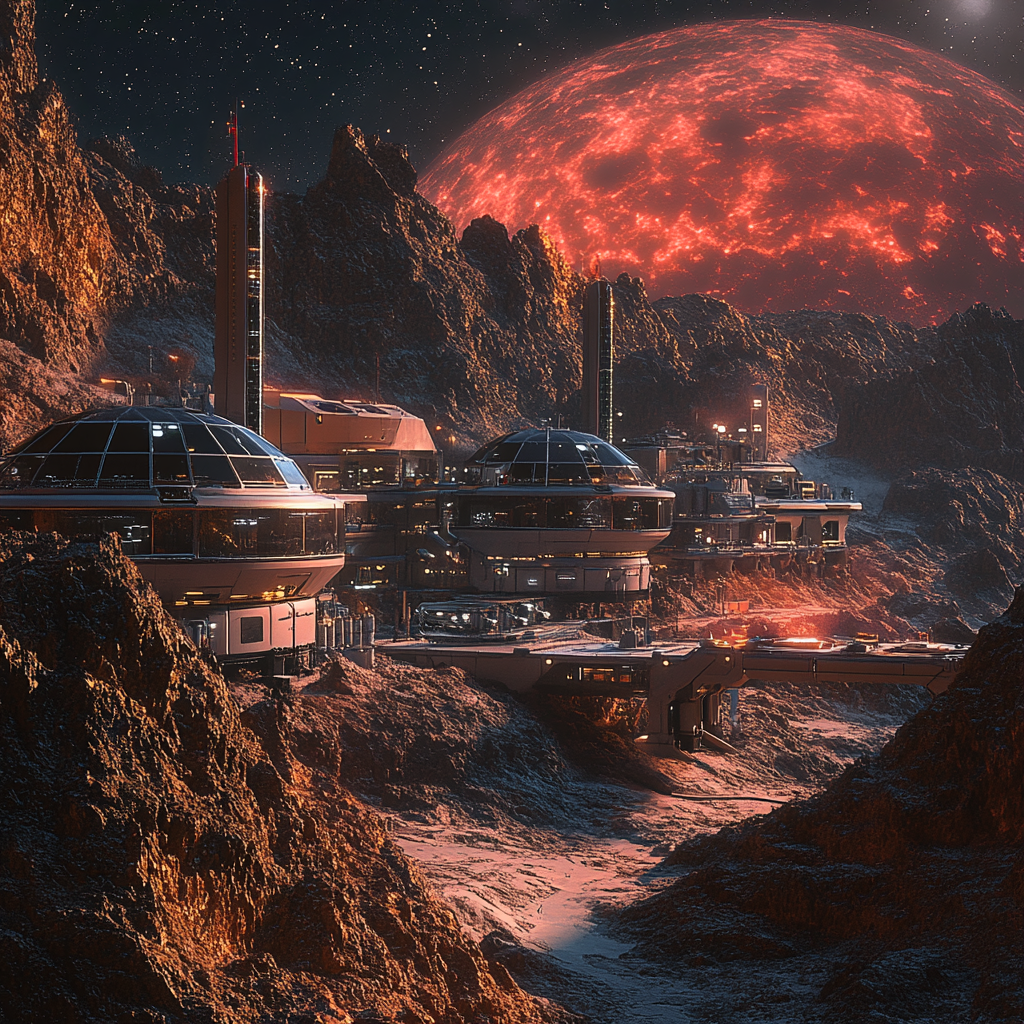
Aurora Base is a pioneering research outpost and fledgling colony established on Proxima Centauri b, the closest known exoplanet to our Solar System. Founded in 2420 through travel via a QETS gate, this settlement represents humanity's first attempt at colonizing a planet orbiting a red dwarf star, presenting unique challenges and opportunities for scientific exploration and technological advancement.
Often referred to as "The Crucible," Aurora Base serves as a proving ground for humanity's capacity to adapt to truly alien environments. The extreme conditions of Proxima Centauri b—tidally locked rotation, intense stellar radiation, and sparse native life—push colonization technologies to their limits while offering unprecedented opportunities for scientific discovery.
Despite its harsh conditions and small population, Aurora Base represents one of humanity's most ambitious achievements in the Corporate Era: a permanent settlement on an exoplanet orbiting another star, demonstrating that humanity's reach extends beyond our own solar system.
Environment
Proxima Centauri b's environment is markedly different from Earth, requiring significant adaptation and protective measures from its human inhabitants. The planet's unique characteristics stem from its proximity to Proxima Centauri, a red dwarf star, and its tidally locked rotation.
Hydrosphere and Water Resources
The planet has limited surface water, with most of its hydrosphere locked in underground reservoirs and polar ice caps. Small, shallow seas dot the landscape, covering approximately 15% of the surface. These seas provide crucial resources for the colony but require extensive processing to become potable.
Underground aquifers accessed through deep drilling operations supply the majority of Aurora Base's water needs. The ice caps, while abundant, remain largely untapped due to the extreme cold in permanently dark regions and the energy costs associated with ice extraction and melting.
Temperature Extremes and the Twilight Belt
Due to its tidally locked nature—where one hemisphere perpetually faces the star while the other remains in eternal darkness—Proxima Centauri b experiences extreme temperature variations. The star-facing side reaches scorching temperatures incompatible with human habitation, while the dark side plunges to frigid extremes where even atmospheric gases condense.
The habitable zone, often referred to as the "twilight belt," exists in the narrow band where perpetual dusk creates more moderate conditions. This region maintains temperatures between -20°C to 30°C (-4°F to 86°F), varying with local topography and atmospheric circulation.
Aurora Base is situated in this twilight belt, utilizing advanced thermal regulation systems to maintain a stable living environment within its habitat modules. Exterior operations require heavily insulated suits with active heating or cooling depending on proximity to the star-facing or dark hemispheres.
Stellar Radiation
Red dwarf stars like Proxima Centauri emit intense stellar flares that bathe the planet in radiation dangerous to both humans and electronics. Aurora Base's structures incorporate heavy radiation shielding, and external operations are carefully timed to minimize exposure during stellar activity.
This radiation environment has driven innovation in protective materials and shielding technologies that have applications throughout human space, making Aurora Base's challenges valuable for advancing general colonization capabilities.
Native Life
Plant life on Proxima Centauri b is sparse and primarily microbial, representing an early stage of biological evolution or perhaps adaptations to the planet's harsh conditions. The discovery of any native life—however primitive—on Proxima Centauri b confirmed that biological processes can emerge around red dwarf stars, expanding understanding of where life might exist in the galaxy.
Indigenous Organisms
The most notable native organisms include:
Extremophilic Bacteria
Thriving in the harsh conditions of the planet's surface, these microorganisms survive through chemosynthesis, extracting energy from chemical reactions in the planet's mineral-rich soils rather than photosynthesis. They represent some of the hardiest life forms known to humanity.
Photosynthetic Microorganisms
Adapted to utilize the red dwarf star's unique light spectrum, these organisms perform photosynthesis under wavelengths different from those used by Earth plants. Their biochemistry offers insights into alternative pathways for capturing stellar energy.
Hardy, Lichen-like Growths
Found in protected areas within the twilight belt, these multicellular organisms represent the most complex native life discovered on Proxima Centauri b. They form symbiotic relationships between photosynthetic and chemosynthetic microorganisms, creating resilient colonies capable of surviving the planet's temperature swings.
Xenobiology Research
The study of these native organisms forms a major research focus at Aurora Base. Understanding how life adapts to red dwarf planetary environments provides crucial data for identifying potentially habitable exoplanets and recognizing biosignatures in atmospheric analysis of distant worlds.
Human-Introduced Agriculture
Human-introduced plants are cultivated exclusively in sealed, carefully controlled biodomes that maintain Earth-like atmospheric conditions and use full-spectrum artificial lighting to supplement the red dwarf's output.
Controlled Environment Agriculture
The biodomes represent marvels of closed-system ecology, recycling water, nutrients, and atmospheric gases with near-perfect efficiency. Multiple redundant systems ensure food production continues even during equipment failures or stellar flare events that might disrupt power supplies.
Crops grown in these facilities provide fresh produce to supplement processed foods imported from Earth and other colonies. The psychological benefits of fresh food in such an isolated environment cannot be overstated—the biodomes also serve as recreational spaces where colonists can experience greenery and natural scents.
Genetic Modification Research
Ongoing genetic modification research aims to develop plant species capable of surviving in Proxima Centauri b's challenging conditions. Scientists work to create varieties that can photosynthesize under red dwarf light spectra, tolerate temperature extremes, and resist the planet's elevated radiation levels.
Success in this endeavor would dramatically reduce Aurora Base's dependence on sealed biodomes, potentially enabling surface agriculture in protected areas of the twilight belt. This research has broader implications for terraforming efforts and agricultural adaptation to alien environments throughout human space.
Economy and Primary Industries
Aurora Base's economy is centered around scientific research and technological development rather than resource extraction or manufacturing. The colony functions primarily as an investment in knowledge and capability-building, with economic returns measured in scientific discoveries and technological innovations rather than conventional commodities.
Exoplanetary Science
The base serves as a premier research station for studying red dwarf star systems and their potential for hosting life. Proximity to Proxima Centauri enables detailed observation of stellar behavior, planetary atmospheric dynamics, and the complex interactions between red dwarf radiation and planetary environments.
This research has identified several potentially habitable exoplanets around other red dwarfs, guiding humanity's broader exploration and colonization efforts. Since red dwarfs represent the most common type of star in the galaxy, understanding their planetary systems has profound implications for where humanity might expand.
Advanced Materials Research
The extreme conditions on Proxima Centauri b drive innovation in materials science, particularly in radiation-resistant and thermally adaptive materials. Protective equipment and structural materials developed at Aurora Base have found applications in radiation shielding for spacecraft, habitats in high-radiation environments, and equipment for other hostile planetary surfaces.
The base's materials laboratories test new compounds and composites under real-world conditions that would be difficult or impossible to replicate elsewhere, making Aurora Base invaluable for materials validation and development.
Xenobiology
Study of the planet's microbial life forms offers insights into the potential for life in extreme environments and the biochemical adaptations that enable survival around red dwarf stars. This research informs the search for life on other exoplanets and helps identify biosignatures that might indicate life in atmospheric analyses.
The xenobiology program has expanded humanity's understanding of possible biochemistries and metabolic pathways, challenging assumptions about what forms life might take in different stellar environments.
Interstellar Communication Technology
The proximity to Earth (relatively speaking—4.24 light years) makes Aurora Base an ideal testing ground for new long-distance communication systems. While QETS gates enable instantaneous physical transit, electromagnetic communications still travel at light speed, creating an eight-year round-trip communication delay.
Researchers develop protocols for managing societies and coordinating activities across such delays, creating frameworks applicable to even more distant colonies. Quantum entanglement communication experiments also utilize the Earth-Aurora Base link as a testbed for technologies that might someday enable instant communication across interstellar distances.
Closed-System Ecology
The base's isolated nature provides opportunities to develop and refine self-sustaining habitat technologies. Aurora Base must recycle virtually everything—water, air, nutrients, and even waste heat—creating one of the most efficient closed-loop life support systems humanity has developed.
Lessons learned at Aurora Base improve habitat designs throughout human space, from orbital stations to deep-space vessels to other planetary colonies. The base serves as a living laboratory for sustainability technologies with applications extending far beyond Proxima Centauri b.
Population
As of 2555, Aurora Base has a small but growing population of approximately 5,000 inhabitants. The population consists primarily of scientists, researchers, and essential support staff, though a growing number of permanent residents are establishing Aurora Base as more than just a research outpost.
Origins of the Population
The initial colonization team comprised 100 highly specialized individuals selected from a pool of volunteers across Earth and established space colonies. This core group underwent extensive training and psychological evaluation to ensure they could function effectively in Aurora Base's isolated, confined environment.
Initial Specializations
The founding team included:
- Astrophysicists and Planetary Scientists: To study Proxima Centauri and its planetary system
- Xenobiologists and Exobotanists: To investigate native life and develop adapted Earth organisms
- Environmental Systems Engineers: To maintain life support and habitat systems
- Medical Professionals: Specializing in space medicine and isolated environment health challenges
- Psychologists: With expertise in isolated, confined environments and group dynamics
Rotation System and Permanent Residents
Subsequent rotations have brought additional researchers and support personnel, typically serving tours of 2-5 years. The rotation system ensures fresh perspectives and prevents psychological burnout while maintaining institutional continuity.
However, a small number of permanent residents, including some children born on the base, form the nucleus of what has become a long-term settlement. These permanent residents represent Aurora Base's evolution from temporary research station to genuine colony—people who consider Proxima Centauri b home rather than merely a workplace.
Notable Residents
One notable resident, born at Aurora Base, is Dr. Anya Sorenson, who became a well-known and highly respected science personality on EuroCore Pulse. Dr. Sorenson's unique perspective as someone who spent formative years on an alien world brings distinctive insights to discussions of humanity's place in the universe.
Her birth at Aurora Base represents a symbolic milestone—the first generation of humans born beyond our solar system, truly children of the stars rather than merely visitors to other worlds.
AI and Robotic Population
The population also includes a significant number of advanced AI systems and robotic assistants, crucial for operations in the harsh external environment. These artificial intelligences handle tasks too dangerous for humans—exterior maintenance during stellar flares, deep drilling operations, and atmospheric sampling in extreme temperature zones.
The ratio of AI to human population at Aurora Base exceeds that of most other settlements, reflecting the colony's dependence on automation for survival in hostile conditions.
Infrastructure and Habitat Design
Modular Architecture
Aurora Base's structures utilize modular design principles, allowing expansion and reconfiguration as the colony grows. Heavily shielded habitat modules connect through pressurized corridors, creating a network of living spaces, laboratories, and support facilities.
The modular approach enables damaged sections to be isolated and repaired without compromising the entire base, providing redundancy crucial for survival in such an unforgiving environment.
Power Generation
The base relies primarily on fusion reactors for power, supplemented by solar arrays positioned to capture the red dwarf's output. The fusion systems provide reliable baseline power regardless of stellar activity, while solar arrays contribute during calm periods, storing excess energy for use during stellar flares when solar generation becomes unreliable.
Transportation and Mobility
Surface transportation utilizes heavily shielded rovers capable of operating across the twilight belt's temperature gradients. The QETS gate that enables transit to and from Aurora Base remains the colony's lifeline to the rest of human civilization, providing rapid evacuation capability in emergencies and enabling personnel rotations without decades-long voyage times.
Challenges and Adaptation
Psychological Isolation
Perhaps the greatest challenge facing Aurora Base residents is psychological rather than physical. The knowledge that Earth lies 4.24 light years away, that any electromagnetic message takes over eight years for a round trip, creates profound psychological isolation even with QETS gate access.
The base maintains extensive virtual reality facilities allowing residents to experience simulated Earth environments, and regular cultural events help maintain morale and community cohesion.
Medical Challenges
The unique radiation environment and reduced gravity (approximately 0.9g) create novel medical challenges. Long-term health monitoring tracks effects that might not appear for years or even generations, contributing data crucial for understanding human adaptation to alien worlds.
Supply Chain Dependence
Despite efforts toward self-sufficiency, Aurora Base remains dependent on regular supply deliveries from Earth and other colonies for specialized equipment, replacement parts, and items that cannot be manufactured locally. This dependence represents a vulnerability that drives ongoing research into in-situ resource utilization and advanced manufacturing techniques.
Significance
Aurora Base represents humanity's boldest step yet in exoplanetary colonization, pushing the boundaries of our understanding of alien environments and our ability to adapt to them. Despite its challenges, the base serves as a beacon of human curiosity and perseverance in the face of the unknown.
The colony demonstrates that humanity can establish permanent settlements around other stars, that we can adapt to conditions radically different from Earth, and that the knowledge gained from such endeavors justifies the enormous investment required. Aurora Base proves that humanity's future extends beyond our solar system—that we are truly becoming an interstellar species.
Every challenge overcome at Aurora Base makes the next colony slightly easier, every technology developed there enables expansion to even more hostile environments. The Crucible lives up to its nickname, forging humanity into something capable of thriving anywhere in the galaxy.
As the first exoplanetary colony, Aurora Base occupies a unique place in human history—the first step toward a future where humanity inhabits countless worlds around distant suns, no longer confined to a single star system but spread throughout the galaxy.