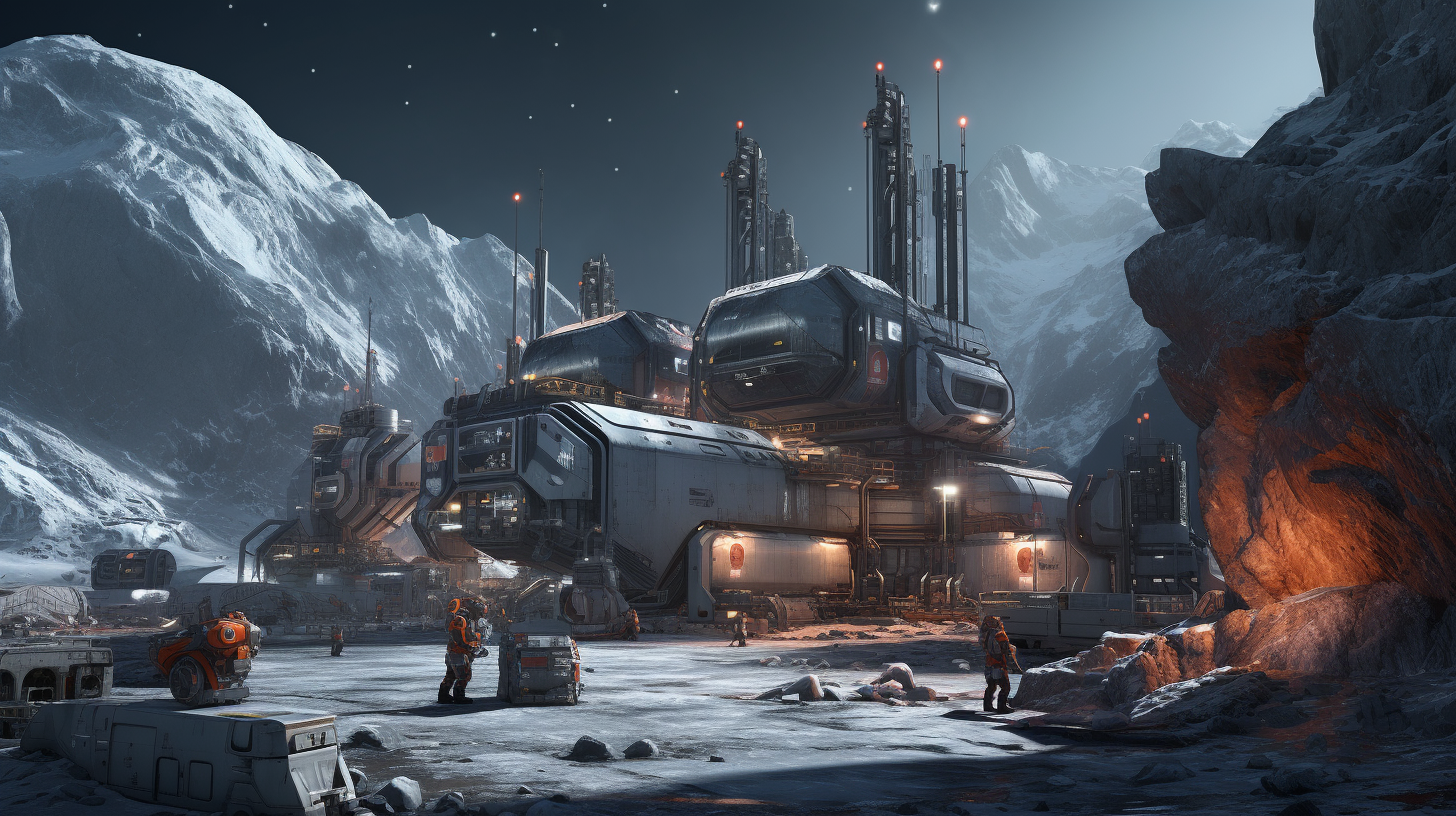
The Rush Era spans roughly 288 years, or 10 generations, from 2150 to 2438. The Rush Era begins at the point where the countries of the Earth begin a rush to space with the goal of capturing resources on and around the planets of their solar system. The rush is kicked off by advancements in prospecting and mining realized from collaboration with the Vox. These advancements dramatically improve the survivability of humans in space and other harsh environments as well as technology and techniques to make interstellar mining much safer.
The Rush Era is noted by an initial period of national and corporate competition to get into space, followed by greatly fluctuating Earth economies as resources periodically flood markets, and establishment of sprawling colonies on near Earth moons and planets as more human workers choose to stay in space over commuting to and from Earth.
Economic Transformation
During the Rush Era, economic disturbances from flooding of interstellar resources into world markets cause changes to established political boundaries as countries fail and are absorbed by neighboring countries or unions.
Geopolitical Restructuring
Formation of Eurocore
After protracted wars in the region during the Earth Era, Russia has failed and is merged into the European Union (EU) with an EU panel collectively managing the Russian economy to restore it and support the people. All Slavic countries surrounding Russia join the EU shortly afterward. Outlying countries fold into the EU and the European Union is renamed Eurocore.
Rise of Amazonia
Climate change on Earth has caused loss of arable land in portions of the world; either as the result of tidal flooding, increased average temperature, or pollution of the soil.
Mexico has become largely uninhabitable due to increased temperatures and lack of water, causing the entirety of this population to push southward. South American countries slowly merge into one large populace of interconnected cities known as Amazonia.
Emergence of Canamer
The Eastern seaboard and entire southern half of the United States, from southern California across to North Carolina, become largely uninhabitable due to dramatic flooding, storms, and increased temperatures. This causes major corporations and businesses to relocate to the north eastern portion of the U.S., bringing the majority of the populace with them. Global temperature increases have opened more land in the northern regions of Canada, and these become critical farmland and sources of water. The United States government fails and, after almost a century, the northern states of the former United States merge with Canada to become a combined entity named Canamer, consisting of two sprawling cities, one on the west coast and one on the east coast, connected by a massive, high-speed rail system between the two. The cities are known as Canamer East and Canamer West.
Demographics of Space Expansion
While the leaders of interstellar mining projects could be of any nationality, many were either Chinese or American. The vast majority of workers heading into space for mining jobs were Slavic (Russian, Ukrainian, Polish) people from Eurocore.
Linguistic Impact
The impact of the Rush Era on the common language of humanity is that it normalized the usage of everyday language around an English derivative; however, the impacts of early Russian and Chinese miners have caused a mixing of these languages into everyday life.
Key Milestone
2406 AD - Gate Transit Breakthrough
The development of ships and processes allowing humans to safely traverse through a Vox gate creates opportunities to settle in remote parts of the known universe.