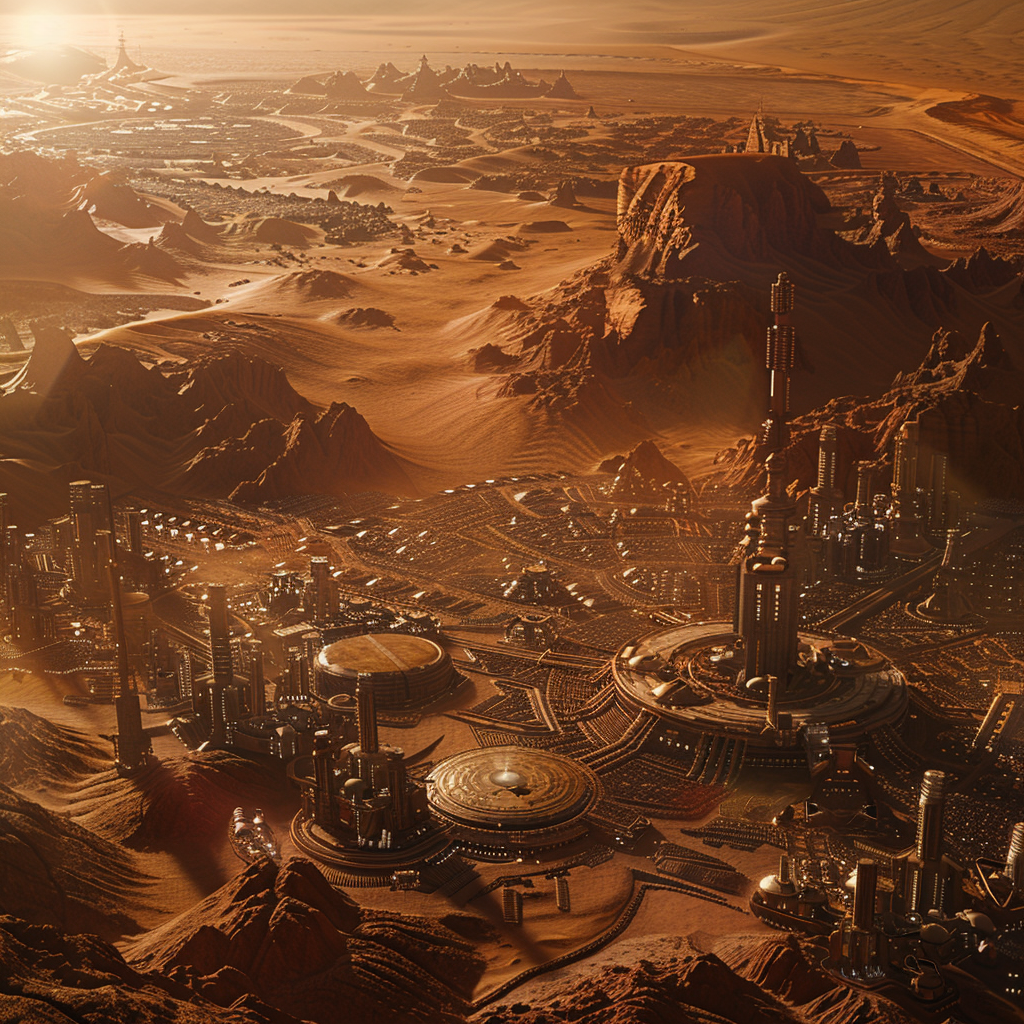
Ares is a major settlement on Mars during the Corporate Era, established within the vast Valles Marineris canyon system. Originally founded as a base for Martian surface exploration, it has evolved into a hub for terraforming research and sustainable living technologies, housing approximately 250 million inhabitants.
Geographic and Demographic Profile
Location
Situated within Valles Marineris, Mars's expansive canyon system that spans roughly the equivalent area of Canamer on Earth. The settlement exists beneath clear protective domes that create a lush, tropical environment in stark contrast to the barren Martian landscape beyond.
Nearest QETS Gate
The closest gate to Ares is Gemini Tor, orbiting on the far side of Mars, opposite the Sun.
Population
Ares sustains approximately 250 million inhabitants, making it one of the most significant human settlements outside Earth.
Establishment
Founded in 2120 CE as a preliminary base for Martian exploration, Ares has evolved considerably over the centuries into a sophisticated urban center.
Economic Structure
Corporate Dominance
Ares serves as the headquarters for the five corporations that dominate the universal terraforming industry:
- StellarBloom Solutions
- EcoHarmonix Solutions
- BioSphere Equilibrium Group
- Celestial Nexus Renewables
- Interstellar Synergy Group
These entities evolved from early Martian terraforming initiatives, though the original dream of transforming the entire planet into an Earth-like environment has long been abandoned in favor of more targeted approaches.
Key Resources and Technologies
The settlement is renowned for its advanced technological infrastructure, including:
- Sophisticated terraforming stations
- Water extraction and purification units
- Bio-regenerative life support systems
- Sustainable habitat engineering facilities
Historical Significance
Ares represents one of humanity's earliest successful attempts at establishing a permanent large-scale presence beyond Earth. While the original vision of terraforming the entire Martian surface has been largely abandoned, the technologies developed in Ares have been instrumental in enabling human settlement throughout the solar system and beyond.
Connection to Terraforming
Ares is home to the five corporations that dominate the terraforming industry—EcoHarmonix Solutions, BioSphere Equilibrium Group, Celestial Nexus Renewables, StellarBloom Solutions, and Interstellar Synergy Group. Each of these companies evolved from a long-dead dream of humanity to terraform the planet of Mars into a new home for humanity, recreating Earth. This dream has long been forgotten; however, Valles Marineris represents an area slightly larger than Canamer on Earth and is lush and tropical under clear protective domes.
Socioeconomic Landscape
Despite its technological sophistication, Ares exhibits significant social stratification:
Upper Echelons
Corporate executives and leading researchers enjoy luxurious accommodations within the most desirable sections of the domed environment, with private access to premium resources and services.
Working Class
The majority of the population serves the needs of the terraforming industry, working in various capacities from research assistance to infrastructure maintenance. Living conditions for this demographic are generally adequate but modest.
Lower Economic Strata
Those at the economic margins of Ares society face considerable challenges, including:
- Cramped living quarters in the less desirable sections of the settlement
- Limited access to certain resources
- Employment primarily in menial or hazardous roles supporting the terraforming operations
- Reliance on communal services rather than private amenities
Transportation Infrastructure
Ares connects to the broader human civilization through Gemini Tor, a QETS gate orbiting on the far side of Mars, opposite the Sun. This positioning necessitates coordinated transport between the surface settlement and the orbital gate.
Cultural Identity
The culture of Ares reflects its origins as a scientific outpost that evolved into a corporate center. Its inhabitants often exhibit a pragmatic worldview focused on technological solutions and efficiency, though artistic and cultural expressions unique to Martian existence have emerged over generations of settlement.
Life in Ares
Excerpt from "The Least of Us" by Emilia Novak, EuroCore Pulse
In Ares during the Corporate Era, a poor person's daily life exists within the surreal contrast of a technologically advanced landscape and their stark reality of scarcity. Rising in cramped quarters within the sprawling confines of a terraforming research facility, they awaken to the hum of machinery and artificial light mimicking the Martian sun. Morning starts with a trek to a communal food station, where they collect rationed, nutrient-enhanced cubes designed to sustain, yet offer little in the way of satisfaction.
The search for employment often leads them to the outskirts of the domes, where they toil in menial jobs, such as maintaining the massive terraforming equipment, harvesting bioengineered crops, or performing maintenance tasks for corporate operations, all while earning meager wages that barely cover their basic needs. As they navigate the pristine but unforgiving environment of Valles Marineris, they witness the sprawling facilities of the corporations that dominate the region, where wealth and innovation flourish, starkly contrasting their own struggle for sustenance and stability.
In the evenings, they congregate with fellow workers in makeshift community spaces, sharing stories and forming bonds over shared hardships, hoping for a day when they might break free from the cycle of poverty that confines them. Despite the mechanical landscape around them, it is the warmth of community and resilience that sustains their spirits, igniting dreams of a future where they might finally seize a stake in the world being built above their heads.